SCOPE: Semantic Coresets using Orthogonal Projection Embeddings for Federated Learning
Motivation
Federated learning over large-scale scientific data faces two stubborn obstacles: heavy communication cost from frequent client-server synchronization, and skewed, imbalanced class distributions that degrade learning efficiency. Naively sending more data or more updates does not scale.
Approach
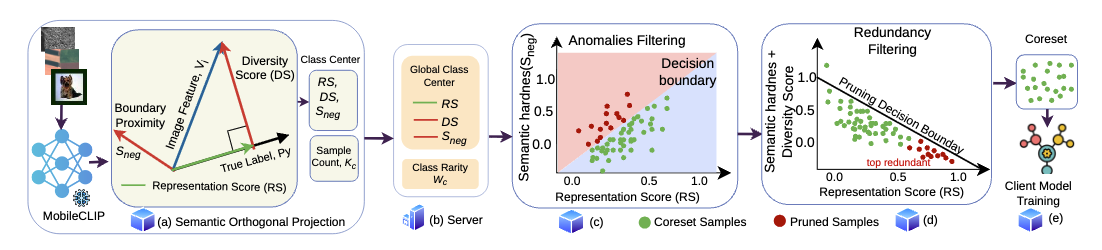
SCOPE constructs semantic coresets, representative subsets selected using orthogonal projection embeddings that capture the meaningful structure of each client's data. By learning on these coresets, clients reduce the volume of information that must be synchronized and transferred, while the projection-based selection preserves the semantic coverage needed for accurate global models.
- Orthogonal projection embeddings to summarize client data semantically.
- Coreset construction that mitigates class imbalance across distributed clients.
- Reduced synchronization and communication overhead at scale.
Context
SCOPE was developed during my Ph.D. internship at Pacific Northwest National Laboratory, targeting federated learning over distributed scientific datasets where centralizing raw data is neither practical nor permitted.